The short answer
Most food packaging projects in Malaysia go wrong in the same place: the artwork is approved on screen, the printer flags a missing statement, and the design goes back for a second round with the launch date already booked. The fix is to treat the label as a regulated document from day one. The Food Regulations 1985, made under the Food Act 1983 and enforced by the Ministry of Health's Food Safety and Quality Division, say what must appear, in which language, at what size. The 2024 amendment added more. Everything below is what a brief should contain before anyone opens a design file.
What the law requires on a food label
Regulation 11 lists the particulars every package of food for sale must carry. In the order a designer meets them:
- The name of the food — its "appropriate designation", or a description with the common name of the principal ingredient. Since 2024, if the main ingredient has no common name, a descriptive term that does not mislead, plus the true nature or physical condition of the product (powder, paste, cordial, crackers). Regulation 12 requires this name to be the most prominent text on the label — more prominent than anything except the trade mark.
- "Mixed" or "blended" conjoined with the name where the product is one.
- "CONTAINS BEEF / PORK / LARD" where any is present, immediately below the name.
- "CONTAINS ALCOHOL" where alcohol is added — capital, bold, non-serif, at least 6 point, immediately below the name.
- The ingredient list in descending order by weight, using common names. Animal-derived ingredients must name the animal unless it is obvious from the ingredient's name.
- Allergen declarations — the regulations name the groups: cereals containing gluten (wheat, rye, barley, oats), nuts and nut products including peanut and soybean, fish, milk including lactose, and egg.
- Fats and oils — a statement of presence, with the animal or plant they come from.
- Food additives — "contains permitted (type)" and, since 2024, the functional class with the INS number or chemical name.
- Net content — minimum net weight, volume or count; minimum drained weight for food packed in liquid.
- Name and business address of the manufacturer or packer (local), or of the manufacturer plus the Malaysian importer (imported). A PO box, a code address, or a name only on the cap seal does not count.
- Country of origin for imported food — mandatory since the 2024 amendment.
- Quantitative ingredient declaration (QUID) since 2024 — where an ingredient is emphasised on the pack or characterises the food, its percentage must be stated.
Regulation 11(1)(k) adds "such other particulars as are required for any particular food" — the Part VIII standards for specific foods, which a designer should ask the manufacturer to confirm.
Language, size and colour
- Language (Regulation 10): food produced, prepared or packaged in Malaysia must be labelled in Bahasa Malaysia; imported food in Bahasa Malaysia or English. Either may carry a translation in any other language. The bilingual or trilingual pack is therefore a design decision layered on a legal minimum, not a replacement for it.
- Size (Regulation 12): every required particular at not less than 10 point. The ingredient list, the fat and additive statements, the manufacturer details and the nutrition panel may go down to 4 point. "CONTAINS ALCOHOL" has its own 6-point floor.
- Measurement (Regulation 13): point size is measured on the lower-case x-height, or on the capitals if the text is all capitals; every word in a required statement must be the same height; packs too small for the prescribed size may reduce it, but never below 2 point.
- Contrast (Regulation 13(7)): all lettering "in a colour that contrasts strongly with its background". A pale grey ingredient list on a white pouch is a compliance problem, not a style choice.
Date marking
Regulation 14 defines date marking as a date permanently marked on the pack or label — a lot code does not count. Foods listed in the Fifth Schedule must carry one, in one of the permitted forms. For an expiry date: "EXPIRY DATE" or "EXP DATE", "USE BY", or "CONSUME BY" or "CONS BY"; for a date of minimum durability: "BEST BEFORE" or "BEST BEF". The date is written as day-month-year or month-year; a month-year date is read as the end of that month. If the shelf life depends on storage conditions, the conditions go next to the date.
The nutrition panel after 1 January 2024
The Food (Amendment) (No. 4) Regulations 2020 — P.U.(A) 209/2020 — were twice deferred and took effect on 1 January 2024. For packaging design they change three things:
- More products need a panel. The categories under Regulation 18B were extended; sweetened creamer, edible fats and oils, and soups and stocks are among the additions.
- More rows. The panel now lists energy (kcal or kJ), protein, carbohydrate, total sugars, fat and sodium, expressed per 100 g or 100 ml and per serving.
- Claims are tighter. "No added sugar" and "no added sodium" claims have defined conditions; function claims cannot suggest a cure or treatment; the Nutrient Reference Value table was revised.
The Ministry of Health published a Guideline on Labelling Requirements in December 2023 that walks through the amended rules with examples, and its FOSIM portal offers a label check. A brief should state whether the product falls under the mandatory nutrition categories before layout starts, because the panel decides how much of the back panel is left.
What is not in the Food Regulations
Three things clients ask for are governed elsewhere. The halal logo falls under the Trade Descriptions (Certification and Marking of "Halal") Order 2011: only JAKIM or a State Islamic Religious Council (MAIN) can certify food as halal, and only certified products may carry the logo. Barcodes are a retailer requirement, not a legal one. Recycling and "eco" marks are voluntary. None of them substitutes for the particulars above, and the halal mark in particular should never be placed on artwork before the certificate exists.
How a packaging project actually runs
The sequence that avoids the second round:
- Brief with the compliance checklist filled in. Product name and nature, full ingredient list in descending order, allergens, origin of fats, additives with INS numbers, net content, manufacturer details, date format, nutrition panel yes/no, languages.
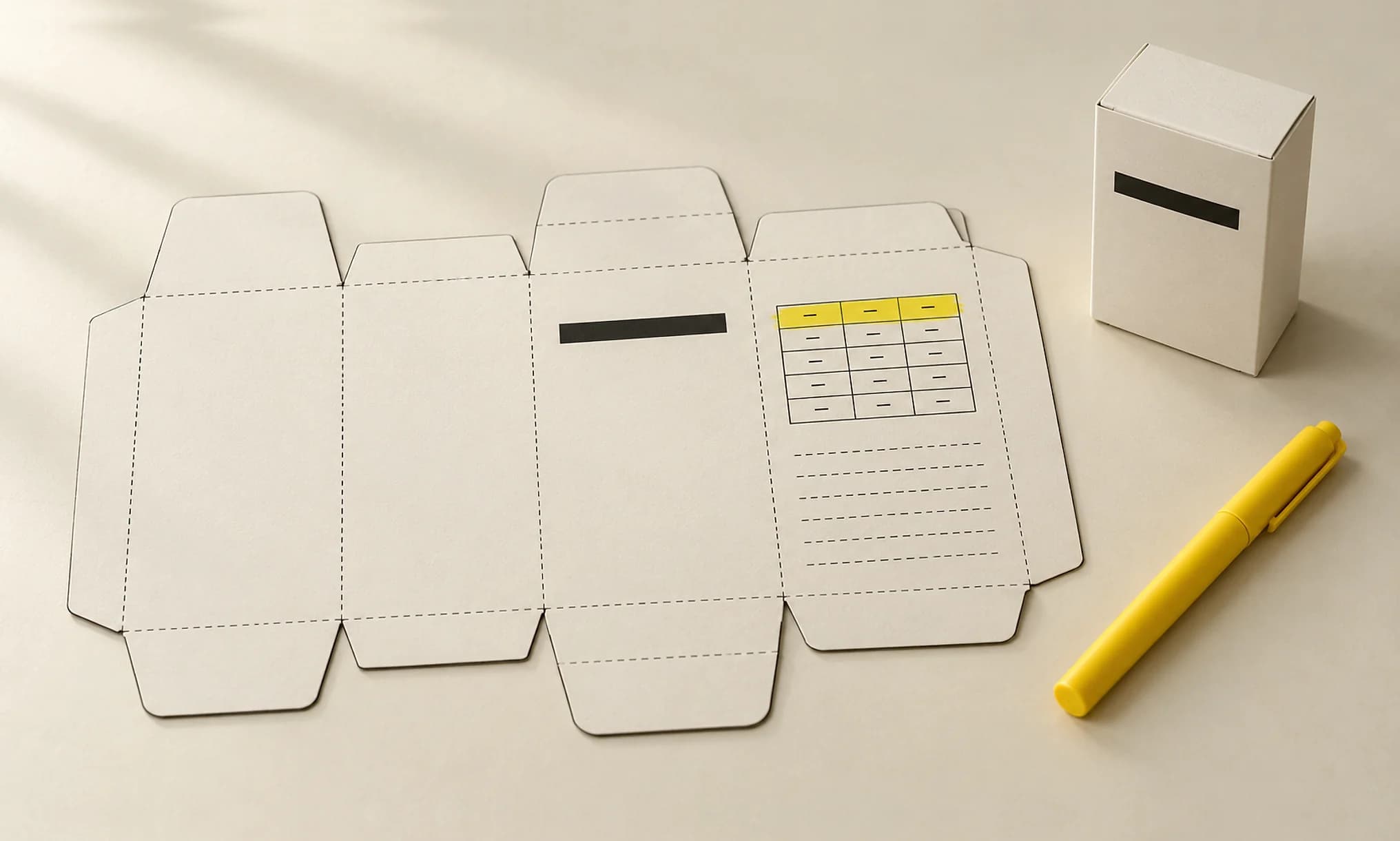
- Structure before graphics. Material, pack format, print method and finishing fix the dieline; the dieline fixes the panels; the panels fix how much text fits at 10 point and 4 point. Designing on a flat rectangle and fitting the dieline later is where type ends up at 3 point.
- Hierarchy. The name of the food must be the most prominent text, so the brand, the flavour and the claim have to be arranged around that rule, not against it.
- Legal text set first, then the design. Set the ingredient list, panel, statements and addresses at their minimum sizes in the brand typeface, lock them, and design the front panel with what remains.
- Shelf test at real size. Print a mock-up, stand it at arm's length under shop lighting, and read the name and the allergen line.
- Compliance check, then print-ready files. A FOSIM check or a food-regulatory consultant's review before the final artwork; then press-ready files with the dieline, colour references and a signed proof.
What it costs in Malaysia
Published figures from local studios put packaging design at roughly RM900 to RM6,500 and above per project, depending on the number of SKUs, whether structural work is included, and how many languages the pack carries. Printing is a separate quote from the converter, and a regulatory review, if used, is separate again. The expensive version of this project is not the design fee — it is reprinting a run because a statement was missing.
Common mistakes
- Approving English-only artwork for a locally made product. The regulation asks for Bahasa Malaysia; translations are an addition.
- Letting the flavour name outrank the food name. "Spicy Original" in 40 point over "Keropok Ikan" in 8 point fails Regulation 12.
- Allergen line buried in the ingredient list in the same grey. It is required to be declared, and it should be readable.
- Lot code used as the date. Regulation 14 says a code "does not constitute date marking".
- Health words on the front. "Health", "tonic", "medicated" and "compounded" are forbidden on labels; "pure" is conditional.
- Halal logo placed before certification. Remove it from the first proof and add it only when the certificate number exists.
What to do next
Before briefing a designer, assemble the twelve particulars above for every SKU in a single document, confirm whether the product is in a mandatory nutrition category, and decide the languages. A designer who receives that brief can give a real quote and a real timeline; one who does not will give both twice.